

This guide is for holistic wellness practitioners who want prospective clients to understand their services before reaching out. Learn how to make a practitioner profile that converts clearer with practical details, adaptable examples, and a simple review process. The goal is to help readers decide whether to take a next step, without pressure or promises about results.
Key Takeaways
- Describe your service, format, and general session structure in everyday language.
- A practitioner profile that converts helps readers evaluate your offer and find a relevant next step.
- Use the fictional before-and-after examples to identify vague wording and make your own copy more specific.
- Review your profile for accuracy, readability, and clear information about in-person, virtual, or hybrid services.
- Once your profile is clear, compare directory plan options with the way you offer your services.
What Makes a Practitioner Profile Easier to Choose From?
A profile can help a prospective client understand what you offer, who may find it relevant, how the service is generally structured, and what to do next. A practitioner profile that converts makes those details easy to evaluate without turning the page into a sales pitch. It can support an informed decision, but it cannot promise inquiries or bookings.
Useful practitioner profile: A clear, accurate description of your services, intended audience, format, and next step, so readers can decide whether to learn more.
A Profile Is More Than a Short Biography
Your introduction gives readers a sense of who you are and what informs your practice. The service description should answer a different question: what does someone need to know to understand the offer? Your background can provide context, but readers shouldn’t have to infer what a session involves or whether its format fits their preferences. For neutral, concise biography-writing principles, see Wikipedia's Manual of Style for Biographies, then adapt the focus to a client-facing profile rather than an encyclopedia entry.
Think of the profile as connected pieces: an introduction, a specific service description, relevant audience context, practical format details, and a next step. Keep your biography focused on information that helps explain your approach. As you revise, review profile improvement options for ways to organize and sharpen the details readers need.
What a Prospective Client Needs to Understand
Start by naming the service in everyday language, then add details that help a reader picture the process. Depending on your practice, explain whether sessions are in person, virtual, or hybrid; whether they are individual or group-based; and what they generally include. Make the next step easy to spot, such as visiting your website or using the contact method you provide. A Welloseek profile shares information, while appointment arrangements follow the practitioner’s stated instructions.
Describe who may find the service relevant without promising a result. For example, you might describe a group as adults interested in a structured space to explore a particular wellness practice. Keep the description within your actual scope, and avoid claims about what participants will experience or achieve.
Illustrative examples only: These fictional descriptions show how adding useful context can make an offer easier to understand.
- Vague: “I offer holistic sessions using several modalities.” The reader still doesn’t know what the service involves, who it may suit, or how it’s delivered.
- More specific: “I offer individual breathwork sessions online for adults interested in guided, reflective practice. Sessions follow a consistent format, and you can visit my website to read more about the approach.” This gives readers practical context without predicting an outcome.
Before publishing, check that each detail is current and easy to scan. Name the service plainly, describe its format, and make the next step simple to find. Those choices help a profile guide a decision while leaving the reader free to decide whether to continue.
Profile Examples: Turn Vague Service Descriptions Into Clear Offers
The examples below are fictional and illustrate ways to make a service easier to understand. They aren’t testimonials or claims about what a practitioner can achieve for someone. Focus on information a reader can use: what the service involves, who it may suit, how it’s delivered, and what the format generally includes.
Specific service details make an offer easier to evaluate. Readers can picture the practical experience and decide whether it fits their preferences, without having to interpret broad phrases or guess what happens during a session.
| Illustrative draft | Clearer version | Why the revision helps |
|---|---|---|
| Vague: “I offer holistic support.” | Fictional example: “I offer individual, in-person breathwork sessions for adults interested in guided breath awareness. A session includes a brief introduction, guided practice, and time for reflection.” | It names the modality, format, intended audience, and general session structure. Readers don’t have to guess what “support” means. |
| Broad benefit claim: “My sessions will help you feel balanced and transform your life.” | Fictional example: “I facilitate one-to-one mindfulness sessions online. We use guided attention practices and reflection, with space to discuss what you’d like from the session.” | The revised version describes the practitioner’s approach without promising a personal outcome. It also makes the online format and session focus clear. |
Example One: Make the Service Description Specific
Start with the plain-language name of the service, then add its format and practical details that matter to a participant. A modality label may be familiar to you but unclear to a new reader, so briefly explain what happens instead of relying on the label alone. For example, say whether the session is guided, individual, in person, or online, and describe one or two elements that reflect your actual offer.
Example Two: Replace Broad Benefits With Useful Expectations
Statements about how a person will feel or what will change can suggest a result you cannot promise. Replace them with details about your role, the activities involved, and the boundaries of the service. Keep the focus on what you provide, not what someone is certain to experience. This gives readers a grounded picture while leaving room for individual preferences.
Use this simple edit to revise your service copy:
- Name the service in familiar words.
- Describe the format and a few relevant parts of a session.
- Say who may find it relevant, without predicting an outcome.
- Check that every statement reflects your actual practice and scope.
Once you’ve clarified your offer, practitioners providing in-person services can explore local listing plan details as one option for presenting that information in a directory profile.
Compare Profile Approaches: Which Details Build Clarity Without Hype?
A useful profile gives readers a grounded sense of what they can explore, not a reason to expect a particular result. Review each detail by asking whether it helps someone understand the service, decide if it may fit, or take a practical next step. A brief profile can work when the offer is straightforward. Add context when the format or process might otherwise be unclear.
Informative profile details explain what a practitioner offers and how it works; outcome claims predict what a reader will experience. This distinction keeps copy clear and measured. A practitioner profile that converts may guide a decision by answering useful questions, but it cannot promise that someone will contact you or book.
Useful Specifics Versus Promotional Language
Words such as “transformative,” “exceptional,” or “life-changing” may sound appealing, but they don’t explain the service. Concrete details give readers something to assess: whether a session is individual or group-based, in person or online, and what activities it generally includes. Use details that accurately reflect your practice, including any scope or availability information you choose to share.
- Less informative: “A powerful, personalized wellness experience.” The reader can’t tell what happens or what the service involves.
- More informative: “Small-group restorative yoga sessions include guided movement and a closing relaxation period.” This describes a format and its general structure without predicting how participants will feel.
- Use with care: Statements about being “the leading practitioner” or having “the most popular approach” need support and may not help a reader understand the offer. A directory listing is not an endorsement or an evaluation of qualifications.
A short profile may need only a plain-language service description, relevant format details, and a next step. Add context if readers could reasonably have questions about how participation works, what the session includes, or whether it is online, in person, or both. Keep extra detail connected to those questions rather than adding promotional adjectives.
Choose Examples That Match the Practice Format
For an in-person service, include practical context about the session format and what participants can expect during a visit. For a virtual service, state that it takes place online and describe how the session is generally structured. If you offer both, explain any differences that matter rather than repeating the same description under every service.
For instance, a fictional hybrid profile might say: “I offer individual sound meditation sessions in person and online. Each session includes a guided listening practice and quiet reflection.” The wording makes both formats visible while staying focused on the service. It doesn’t claim that either format produces a particular effect.
If your service description still feels broad, use guidance on clarifying a service offer to identify the details a reader needs. Then keep, remove, or revise each line based on whether it adds practical context, accurately describes your work, or makes a claim you can’t support.
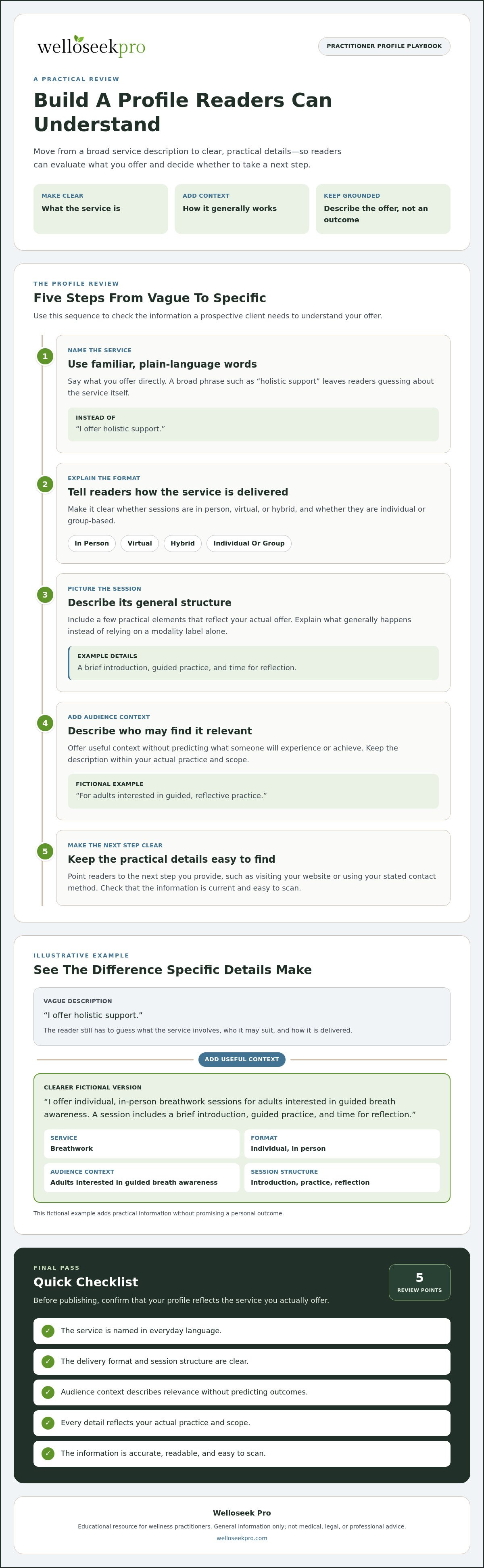
A Practical Profile Review: Edit the Path From First Read to Next Step
A focused review can help you spot where a reader might pause, misunderstand your offer, or struggle to find what to do next. Keep this pass centered on wording and accuracy. Category selection and visibility strategy are separate tasks, so handle them separately rather than letting them distract from a clear, useful description.
Five Steps to Review a Practitioner Profile
- 1. Scan it as a first-time visitor. Read the profile from top to bottom without editing. Note phrases that feel broad, unfamiliar, or incomplete. Mark any point where you have to guess what a service includes.
- 2. Clarify the offer. Check whether the opening names the service plainly. If it starts with a philosophy or a list of modalities, move the most useful service information forward so readers can quickly grasp what you provide.
- 3. Check the practical details. Compare every service description with your current practice. Confirm that the format, general session structure, audience context, and any stated availability are accurate. Remove outdated or overly broad details rather than assuming they still apply.
- 4. Test the next step. Look for what a reader should do to learn more. Make that action easy to find, such as visiting your website or using the contact option you provide. A Welloseek profile shares information; it does not handle appointment scheduling.
- 5. Revise for a clean read. Shorten sentences that carry too many ideas, replace jargon with familiar wording, and remove claims that predict a reader’s experience. Read the updated profile aloud. If it sounds natural and answers basic questions, it is easier to use when considering whether to continue.
Quick Checklist Before Publishing or Updating
Use this final pass after making edits. It keeps the profile consistent and easy to follow without expanding the review into category selection or a broader visibility plan.
- Opening: Does the first part explain the service in plain language?
- Format: Are in-person, virtual, or hybrid details stated clearly where relevant?
- Accuracy: Do the examples and practical details reflect your current offer and scope?
- Claims: Have you removed unsupported statements about results, popularity, or professional standing?
- Next step: Can a reader easily locate and understand how to continue?
- Readability: Can someone scan the profile without needing to interpret unexplained terms?
If the profile is clear and you’re considering a directory option, compare the plan information with the way you offer your services. In-person practitioners can review local plans, while virtual and hybrid practitioners can review virtual plans.
Explore Welloseek Plans
Once you’ve clarified your offer and reviewed the profile details, consider whether a Welloseek directory plan fits your practice. Make the information useful first, then explore options that align with how you work. A clear profile can support an informed choice, but no plan or profile wording promises inquiries, bookings, or income.
Choose a Plan That Fits Your Practice Format
Your service format can guide which plan information to review. Practitioners offering in-person services can explore local plans, while virtual or hybrid practitioners can review virtual plan options. If your business is already listed on Welloseek, you can activate your listing.
Review the information that fits your practice and decide whether it suits your needs. If you’re still refining your profile content, profile upgrade guidance can help you focus on the details that make your offer easier to understand.
Make the Next Step Clear and Low-Pressure
A plan page is a place to review directory options, not a promise of leads or bookings. Compare the available information with your practice needs and choose whether to continue. If you offer in-person services, start with the local plans page. If your services are virtual or hybrid, review the virtual plans page.
Keep refining one detail at a time. A thoughtful edit can make your profile more closely reflect the practice you’re building.
Keep Your Profile Aligned With Your Practice
Your profile can change alongside your work. When your services or preferred session formats shift, revisit the wording and make a small, accurate update rather than waiting for the whole page to feel out of date. A practitioner profile that converts is an ongoing point of clarity, not a fixed script.
Welloseek supports profiles that include multiple modalities and offers free and paid profile tiers. Once your offer is clear, compare the plan information with the way you share your services. Choose at your own pace, with your profile’s purpose and practice format in mind.
View Local Plans
Keep refining one detail at a time. A thoughtful edit can make your profile more closely reflect the practice you’re building.
Frequently Asked Questions
What Does It Mean for a Practitioner Profile to Convert?
It means a reader takes a relevant next step after viewing your profile, such as exploring your website or contacting you through the method you provide. That step doesn’t have to be a booking. Someone may save your details or compare your service with other options before deciding. Treat the profile as one part of a decision process, not a measure of your value as a practitioner.
Can a Directory Profile Turn Every Visitor Into a Client?
No. Visitors have different preferences and may be at different stages of deciding what they need. A profile can help someone understand your practice, but the choice remains theirs. For example, a reader may be looking for a group format while your service is one-to-one. That visitor may not be a fit, and clear information helps both of you avoid relying on assumptions.
Should a Practitioner Profile Include a Call to Action?
Yes, if it points to a useful action and accurately reflects how you prefer people to connect. Keep it direct and low-pressure, such as “Explore session details on my website.” Before publishing, follow the link yourself and check that the destination matches the invitation. If the page describes a different service or offers no useful next step, revise the link or its wording.
How Can I Make My Profile Useful for Virtual and In-Person Services?
Give each format enough context for someone to understand how participation works. For online sessions, state that the service is virtual and describe how a participant receives the relevant information. For in-person sessions, explain practical details that shape the experience, such as whether the service is individual or group-based. If you offer both formats, note meaningful differences without duplicating the full description.
Is a Paid Practitioner Directory Profile Worth Considering?
Consider it in relation to your current goals and the role you want the directory to play in your wider practice presence. Review the plan information, compare it with your needs, and decide whether the available options make sense for you. You might also consider whether your profile is ready to represent your services clearly before investing in greater directory visibility.
What Should I Change First if My Practitioner Profile Feels Unclear?
Read the opening as someone unfamiliar with your work and identify the first question it leaves unanswered. If a reader can’t tell what your main service is, revise that sentence before editing smaller details. Try replacing abstract phrases with the everyday name of the service. Then ask someone unfamiliar with your practice to explain what they understand from the revised opening.
Does Welloseek Book Appointments for Practitioners?
No. Welloseek is a directory for discovering wellness providers, not an appointment booking service. To arrange a session, follow the practitioner’s stated contact or scheduling instructions. Before reaching out, note the service or format you’re interested in and include any relevant question in your message. This can make your enquiry more focused and help the practitioner understand what information you’re looking for.
Reminder: this article is for general informational purposes only and is not medical, legal, or professional advice. Welloseek Pro is an educational resource site for wellness practitioners. Welloseek (welloseek.com) is a directory for discovering wellness providers; listings are not endorsements and do not imply verification of licensure, training, credentials, or results.

Article by
Welloseek Pro Editorial Team
Welloseek Pro provides premium resources for holistic wellness practitioners, brought to you by the creators of Welloseek. Content is for informational purposes only and is not medical, legal, or professional advice.
Disclaimer
Welloseek Pro is an educational resource site for holistic wellness practitioners. This article is for general informational purposes only and is not medical, legal, or professional advice. Welloseek (welloseek.com) is a directory for discovering wellness providers; listings are not endorsements and do not imply verification of a provider’s licensure, training, credentials, or results. If you have a medical or mental health concern, please consult a licensed healthcare professional.
